The most-analysed roles in April: which jobs companies want to automate
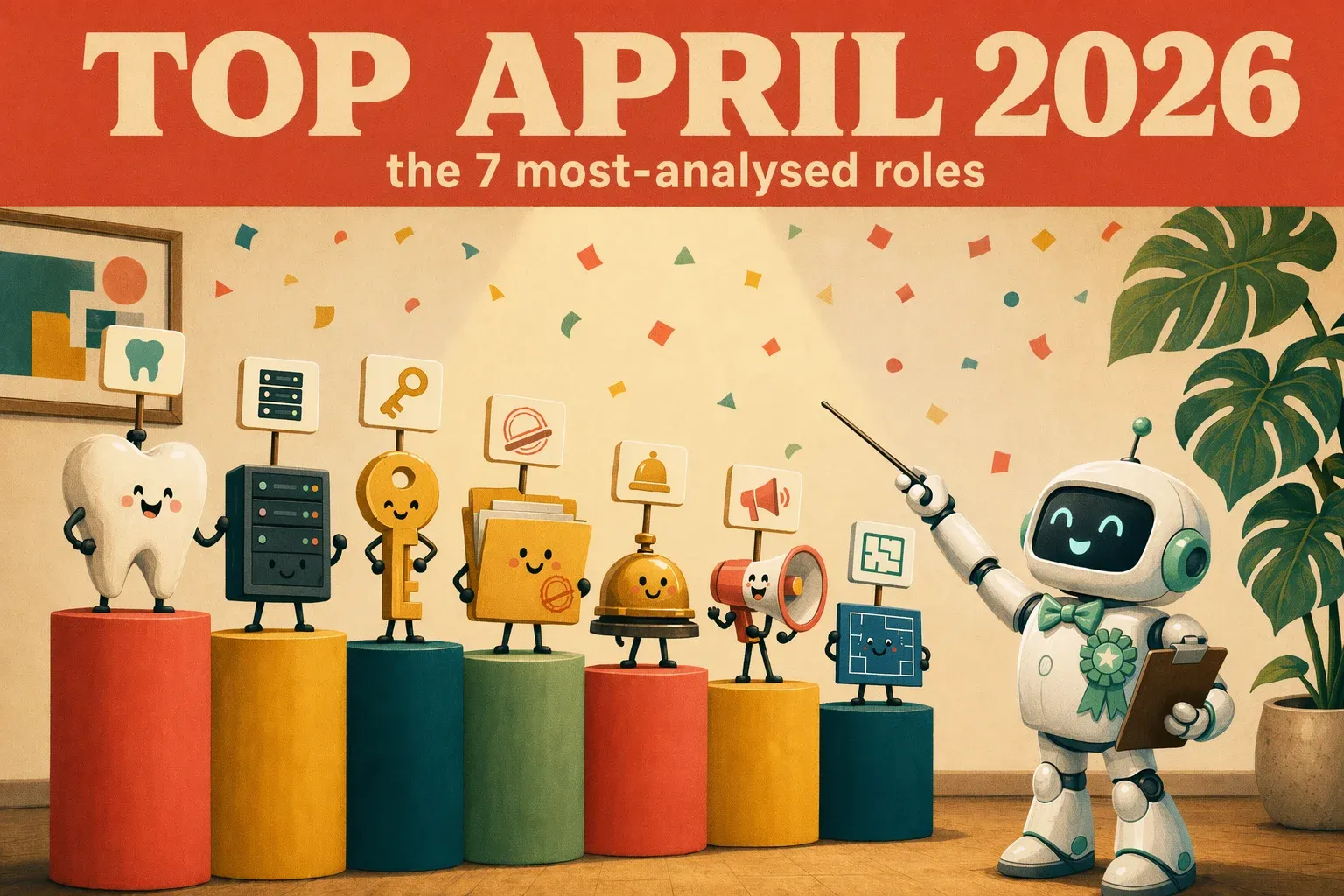
Seven concrete roles run through canihireanai.com during April 2026. Score, hours recovered, savings, and payback.
Every analysis run on canihireanai.com is someone who sat down to describe a real role and clicked “analyse.” It’s not a survey of intent: it’s work someone is thinking about automating.
In April, seven roles came up repeatedly. Three from professional services, two from customer operations, one from technical support, one from communications.
Below are the seven, with the score the diagnostic returned, the hours recoverable per week, and the estimated payback.
Summary — April 2026
| Role | Country | Score | Hours recovered/wk | Annual savings | Payback |
|---|---|---|---|---|---|
| IT support technician L1 | Germany | 82 | 33 h | €19,500 | 5 months |
| Community manager | Spain | 80 | 32 h | €12,500 | 7 months |
| Public funding consultant | Spain | 74 | 30 h | €14,000 | 6 months |
| Hotel reservations manager | Spain | 71 | 28 h | €13,500 | 6 months |
| Independent estate agent | Spain | 71 | 32 h | €19,500 | 5 months |
| Property manager | Spain | 70 | 25 h | €7,850 | 8 months |
| Dental clinic receptionist | France | 68 | 24 h | €9,800 | 7 months |
Three things to read off the table before going into each case.
The score isn’t what helps you decide. Three roles score between 70 and 71, and yet the investment case is very different: the estate agent pays back in 5 months, the property manager in 8. The difference isn’t in how much AI can do, but in how many human hours get freed up and what that hour costs.
No role is “100% automatable.” Every analysis recommends a hybrid model. AI absorbs the repetitive flow — the person keeps the exception, the decision, and the difficult customer.
The average payback this month is around 6 months. That’s a comfortable number for arguing for an internal pilot, not for committing an annual budget. The sensible move is to validate the real saving with a pilot before scaling.

1. IT support technician, level 1 — the clearest case
Score 82 · 33 h/wk recovered · €19,500 saved · 5-month payback
Level 1 IT support is one of the most predictable cases. Repetitive tickets, password resets, access requests, how do I do X in Y tool. AI classifies, answers from internal documentation, and escalates only what needs human judgement.
The analysis for Germany recovers the equivalent of 0.8 FTE — almost an entire technician freed up for architecture, security, and the problems that actually deserve a human. The reason ROI is high here: high salary (€42,000), high volume, ticket structures AI understands natively.
What the tool flags as a risk: identity and access. Any integration has to go through the existing IAM flow with full traceability — the EU AI Act will explicitly require it for support systems that touch critical access.
2. Community manager — high score, slower payback
Score 80 · 32 h/wk recovered · €12,500 saved · 7-month payback
The analysis for a Spanish marketing agency scores very high on automation potential (80), but the absolute saving is lower than IT support — even though it frees almost the same weekly hours.
Why? Lower salary (€30,000), and a creative component that doesn’t disappear, just speeds up. AI generates copy variants and adapts per channel, schedules, listens, and reports. The person decides what gets published, handles crisis moments, and protects brand voice.
A useful pattern to remember: high technical automation potential ≠ high economic return. If the hourly cost is low, absolute savings drop even when AI can do almost everything.

3. Public funding consultant — the “document-heavy work” pattern
Score 74 · 30 h/wk recovered · €14,000 saved · 6-month payback
Probably the most typical SME case in Spain. A public funding consultancy reads regulatory bases, prepares applications, tracks deadlines, gathers documentary evidence, and keeps the CRM up to date.
Each of those tasks, on its own, is exactly what an agent with good document access does well: classify, extract, compare against regulation, remember deadlines. What it shouldn’t do is decide what gets submitted and what doesn’t — that stays with the consultant who signs.
The diagnostic recommends a hybrid model with a regulatory assistant plus document and CRM connectors. The 6-month payback is realistic for this profile because the hours freed up are very operational.
4. Hotel reservations — where “automation” is already a product
Score 71 · 28 h/wk recovered · €13,500 saved · 6-month payback
Hotel reservations is a case where the market already has product. PMS, booking engines, channel managers — AI here doesn’t invent the category, it optimises the cross-channel flow and the multichannel guest interaction.
What’s interesting in the analysis: the tool doesn’t propose replacing the manager, it proposes that a multichannel assistant absorb first contact and coordinate with reception and housekeeping for special requests. The manager keeps OTA relationships, pricing, and exceptions.
Seen this way, the operational question is what the person stops doing so they can focus on what the business actually needs.
5. Independent estate agent — middling score, high ROI
Score 71 · 32 h/wk recovered · €19,500 saved · 5-month payback
Same score as hotel reservations, almost the same profile of hours freed — but the estate agent’s ROI is noticeably higher. The reason is direct: the hourly cost is higher (€45,000 base salary) and there’s a meaningful volume of admin tasks — scheduling viewings, qualifying leads, maintaining listings — that a multichannel assistant can absorb without needing human judgement.
The part that doesn’t get automated is exactly what holds the business together: negotiation, closing, and the trust with owners and tenants. That stays untouched.
For a sole trader or a small agency, this profile tends to be the first defensible investment case: a few months to pay back, no impact on the commercial side, and measurable time freed up.

6. Property manager — high score, weak ROI
Score 70 · 25 h/wk recovered · €7,850 saved · 8-month payback
The property manager scores similarly to the estate agent, but the investment case is noticeably worse. Lower salary (€25,000), slightly fewer hours freed, payback stretching to 8 months.
It’s a role where AI helps — document handling, owner queries, incident tracking — but where the economic case for automating in one go is weak. There’s no point automating everything here: automate the document side and the inbound queries, and leave the residents’ meetings and mediation to the person.
A high score doesn’t always justify a full automation project. Sometimes the right move is a small, well-scoped piece, not a transformation.
7. Dental clinic receptionist — hybrid model, no argument
Score 68 · 24 h/wk recovered · €9,800 saved · 7-month payback
The lowest score in the top seven, and even so the recommended model makes plenty of sense. The dental clinic receptionist — analysed in an independent French clinic — handles a high volume of calls, appointments, reminders, and basic triage, alongside tasks that need empathy and light clinical judgement.
AI absorbs scheduling, reminders, and protocol-based triage. The receptionist keeps urgent cases, conflicts, and the human coordination with dentists and hygienists. The capacity recovered is the equivalent of 0.6 FTE — enough to grow without hiring, not enough to replace a person.
Important in healthcare: any automation here touches patient data. The analysis explicitly recommends reviewing the flow under GDPR before going to production. And in France, also the Code du travail on communication with healthcare staff.
What these seven analyses do — and don’t — say
What they do say.
In April, the pressure to automate came from operations and professional services, not from engineering or leadership. Average payback came in under a year across all cases. And in six of the seven, the recommended model is hybrid — AI handles the flow, the person handles the decision.
They also say that the cost of an hour of human work is the factor that shifts the economics. Two roles with the same score and similar hours freed can have very different investment plans. Before automating, it pays to understand what you’re actually paying for each hour.
What they don’t say.
These seven analyses aren’t a statistical sample. They’re a batch of real cases that ran through a diagnostic tool. They don’t prove most Spanish companies will automate these roles first — they prove these are the questions people are asking today.
And a five-minute diagnostic is a starting point, not a project. Before executing, you need to validate real volumes, available integrations, sector-specific GDPR requirements, and how much change cost the organisation can absorb.
Running your own analysis
If any of these profiles resembles a role on your team, the numbers above work as reference, not as an answer. Every company has its own volume, structure, integrations, and regulated sector.
Start by diagnosing which tasks on your team can actually be automated — free at canihireanai.com