What AI Actually Automates in 2026: Evidence for Spain and the EU

McKinsey says AI could technically automate 57% of work hours; only 31% of companies are scaling it. What the data shows for businesses operating in Spain and the EU.
In Spain, AI adoption among SMEs sits roughly eighteen months behind the German baseline, and Eurostat’s 2025 ICT usage survey shows the EU-27 split between heavy adopters and the long tail is widening, not closing. That gap is the most important fact in the European automation story. The technology has reached production. Most companies have not.
The 2026 debate around AI keeps confusing two different questions: what AI can automate, and what your specific business will actually automate well. The first is settled by Tier 1 research from McKinsey, the WEF, IBM, MIT Sloan and the Federal Reserve. The second is settled by your integration layer, your data quality and your governance maturity, which no global survey can see from the outside.
This post stays close to the data and labels its geography. Where the evidence is European or Spanish, we say so. Where it is US-anchored, we say that too.
For the role-by-role view, see Which Roles AI Is Really Changing. For why most automation projects break at the integration layer, see The No-Code Gap.
Key takeaways
- McKinsey estimates AI could technically automate around 57% of US work hours — a task-level ceiling, not a forecast (McKinsey MGI, Nov 2025).
- 88% of organisations use AI in at least one function; only 31% are scaling it enterprise-wide (McKinsey State of AI, Nov 2025).
- In EMEA, 66% of large-firm leaders report significant productivity gains from AI, concentrated in software, customer service and procurement (IBM IBV / Censuswide, Oct 2025).
- Only 15% of GenAI users report significant measurable ROI; the path to return runs through workflow redesign, not headcount cuts (Deloitte, Oct 2025).
What “automatable” actually means
McKinsey’s November 2025 analysis estimates AI agents and robots could technically automate around 57% of US work hours: 44% via AI software agents, 13% via physical robots (McKinsey Global Institute, Nov 2025). That number gets quoted constantly. It is also one of the most misread statistics in the field.
The methodology matters. McKinsey did not ask “will AI replace this job?”. They asked something narrower: can current tools perform each constituent activity inside an occupation at or above human level under reasonably ideal conditions? That is a technical ceiling at task level. It is not a deployment forecast, an economic prediction or a jobs-lost estimate.
A task being technically automatable means the capability exists. It does not mean a business will adopt it, that the integration will work, or that the economics justify the investment. Most of the 57% sits behind those three filters. In Spain and the EU it sits behind a fourth: regulatory conformity under the EU AI Act and the GDPR.
The 44%/13% split also tells you how the automation arrives. Software agents — models that take instructions, use tools and complete multi-step tasks inside digital systems — make up the vast majority. Physical robots are smaller and slower-moving. The near-term automation story in Europe is almost entirely a software story, and it lands first on white-collar work.
Where AI is already delivering — sector by sector
The productivity gains are real. They are also concentrated. IBM’s October 2025 EMEA survey of 3,500 senior business leaders found that 66% report significant operational productivity gains from AI (IBM Institute for Business Value / Censuswide, Oct 2025). The top three functions: software development and IT (32%), customer service (32%) and procurement (27%).
These three categories share a structure. High volumes of structured, text-based work where AI has clear skill: ticket classification, code review, draft generation, purchase-order matching, response routing. The gains do not come from AI “doing the job”. They come from AI handling the most repetitive slices of a job so the humans can handle the parts that need context.
Concretely, what does that look like inside a European mid-cap?
- In software development, a model runs a first pass on pull-request diffs, flags likely bugs and generates test scaffolding.
- In customer service, intent detection routes tickets before a human reads them and a model drafts a reply the agent edits and sends.
- In procurement, automated three-way matching of invoice, purchase order and delivery receipt removes a clerk’s cross-referencing work.
The WEF gives a useful trajectory: today 47% of work tasks are performed primarily by humans, 22% mainly by technology and 30% via human-machine collaboration. By 2030 those proportions are projected to converge toward roughly equal thirds (WEF Future of Jobs Report 2025, Jan 2025). Gartner adds the near-term signal: roughly 40% of enterprise applications will feature task-specific AI agents by end of 2026, up from less than 5% in 2025 (Gartner, Aug 2025). That is not AI replacing enterprise software. It is AI agents embedded inside the SaaS your team already uses.
The adoption gap between US, Germany and Spain
The most striking data point in McKinsey’s November 2025 State of AI is not how many companies use AI. It is the shape of where they are in the process. 88% of organisations report regular AI use in at least one function, up from 78% the prior year. Only 31% are scaling AI enterprise-wide. The other 62% sit in pilot or experimentation (McKinsey State of AI, Nov 2025, n=1,993, 105 countries).
This is not a technology gap. It is an implementation gap. And it has been sitting in the same place for two years.
The geographic distribution makes the European picture sharper. The US Federal Reserve found that only about 18% of US firms have adopted AI at the business level, but 78% of the labour force works at firms that have (U.S. Federal Reserve Board, FEDS Notes, Apr 2026). Adoption is concentrated in large employers. Mid-market and SMEs largely have not moved.
That same pattern holds in Europe with one extra layer. Eurostat’s 2025 ICT survey shows AI adoption among EU-27 enterprises clustered in Denmark, the Netherlands, Finland and Germany; Spain, Italy, Portugal and most of Eastern Europe sit clearly below the EU-27 average. Inside Spain, the gap between IBEX-listed companies and the wider SME tissue is wider still. When IBM reports that 66% of large-firm executives see gains, they are sampling from the top of that distribution. Most Spanish SMEs are not in those surveys.
There is also the Deloitte ROI paradox. Only 15% of GenAI users report significant measurable ROI, while 85% of organisations increased AI spending in the past 12 months (Deloitte Global, Oct 2025, n=1,854). Most use cases need two to four years to reach satisfactory return. Buyers are committing to conviction before evidence — not irrational, but worth naming. The 2026 automation story is being written ahead of the data.
What AI cannot automate — and why that matters
The automation boundary is not blurry. MIT Sloan research published in March 2025 identifies five capability clusters where AI consistently underperforms: Empathy, Presence, Opinion and Judgment, Creativity, and Hope — the EPOCH framework (MIT Sloan, Mar 2025). These are not soft, unmeasurable traits. They are identifiable task attributes that can be coded and scored at the O*NET occupation level.
The finding most coverage misses: tasks added to the O*NET taxonomy in 2024 — the new work arriving in today’s workforce — show higher EPOCH requirements than the tasks that existed before AI arrived. New work is becoming more human-intensive, not less.
The tasks being added to the workforce score higher on the very capabilities AI struggles with most. Automation is not flattening human work. It is concentrating it. — MIT Sloan EPOCH research summary (MIT Sloan press release, Mar 2025)
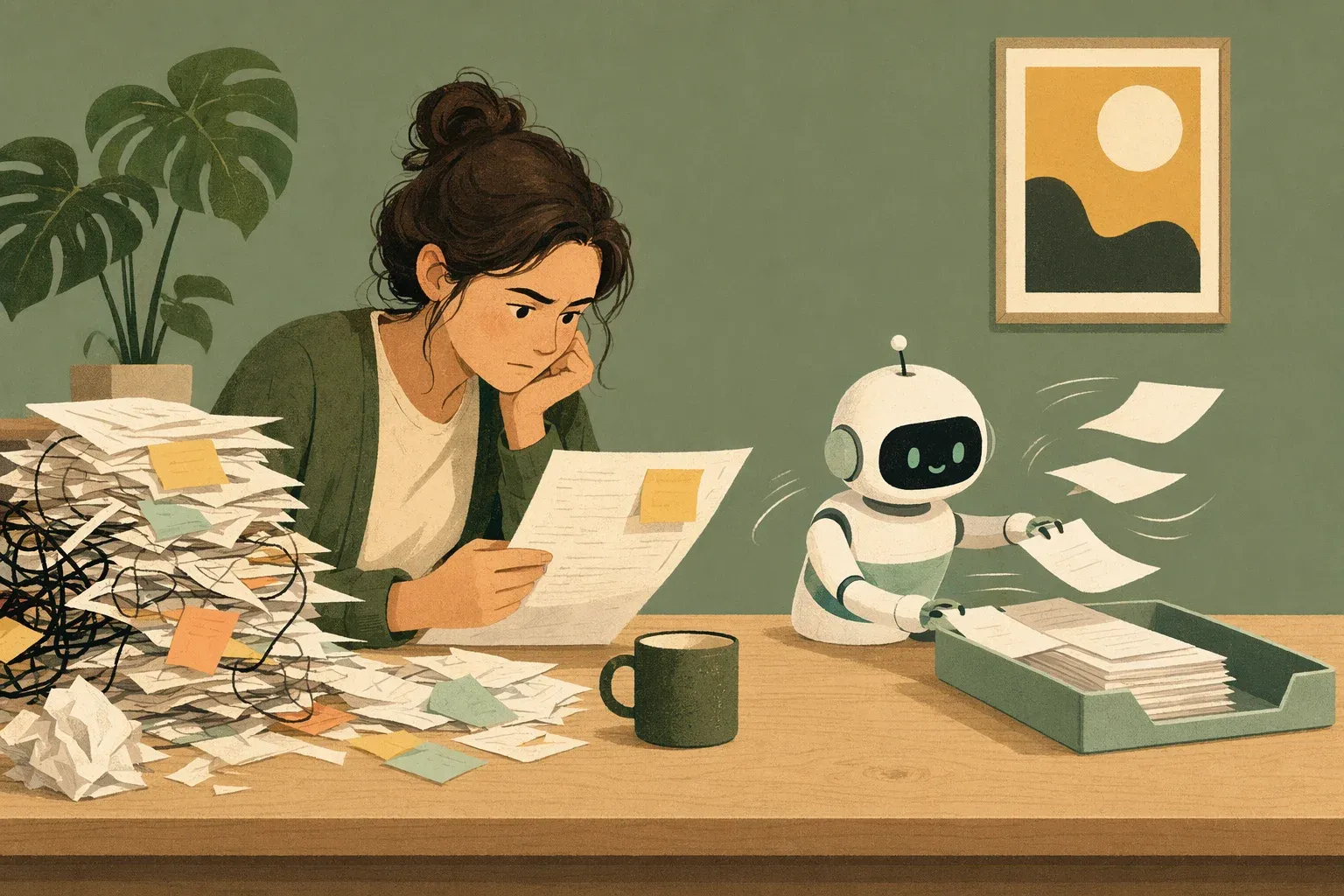
What does that look like in practice? A customer service agent whose ticket-routing tasks are automated does not become redundant. The remaining interactions are the escalations: the angry customer, the nuanced complaint, the case the script does not cover. Those need Empathy and Presence. Automating the easy tickets concentrates hard human judgment in the same role.
The WEF data points the same way. 39% of existing worker skill sets will be reshaped or become outdated between 2025 and 2030. That is a large number, but “reshaped” is not “eliminated” (WEF Future of Jobs Report 2025, Jan 2025). AI fluency demand in job postings grew roughly 7x between 2023 and mid-2025 (McKinsey MGI, Nov 2025). The skills picture is shift, not erasure.
The 57% ceiling vs. your actual business
Forty percent of employers expect to reduce their workforce where AI can automate tasks. Two-thirds of those same employers plan to hire talent with specific AI skills (WEF Future of Jobs Report 2025, Jan 2025). Both can be true. Headcount can shrink in some roles while growing in others.
So what does the 57% technical ceiling mean for your business? McKinsey points to roughly $2.9 trillion in economic value potentially unlocked in the US by 2030 through workflow redesign and augmentation (McKinsey MGI, Nov 2025). The operative phrase is “workflow redesign and augmentation”. The value comes from restructuring how work flows, not from removing the people doing it.
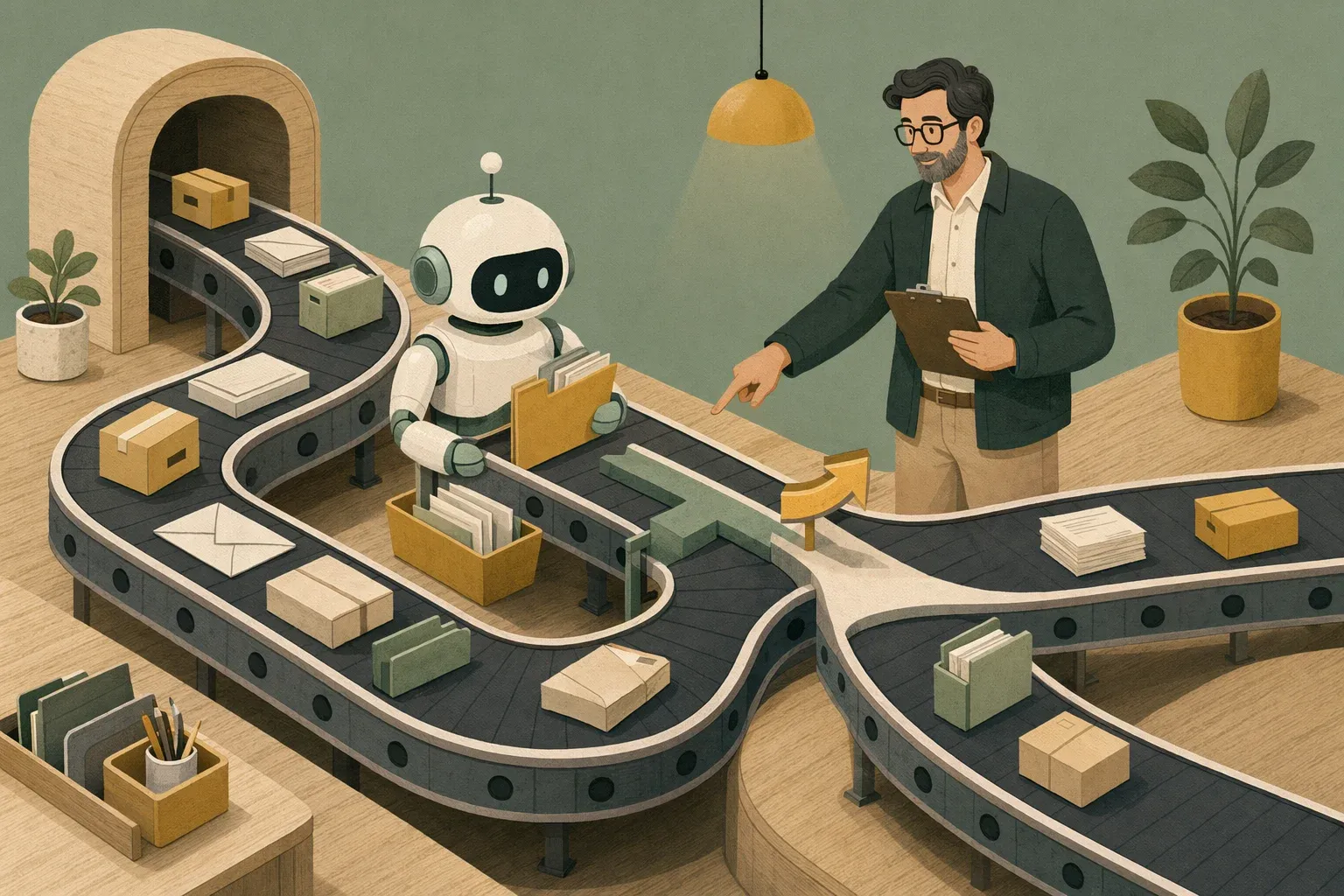
That changes the diagnostic question. The right question is not “which of my employees could an AI replace?”. It is “which tasks within which roles meet the actual conditions for reliable automation?”. Those conditions are specific: the task is high-volume, the inputs are structured (or can be structured), the output can be evaluated at acceptable quality, and the integration layer between AI and your existing systems can be built at reasonable cost.
Most vendor demos skip the last two. They show the model performing the task in isolation. They do not show the integration layer breaking at 03:00 or the evaluation framework that catches quality drift before it reaches customers. That gap, again, is the integration layer — covered in detail in The No-Code Gap.
The 86% of employers expecting AI to reshape their business by 2030 are not wrong. The change is coming. What the data does not tell you is whether your specific processes meet the conditions where automation generates durable return rather than a failed pilot and a line item on last year’s budget.
The 2026 automation debate is noisier than it needs to be. The underlying picture is fairly coherent: AI handles a substantial share of structured, text-based, high-volume work; performs poorly on judgment, empathy, creativity and physical presence in unstructured environments; delivers real gains in specific functions; and resists ROI at scale.
What no global dataset can resolve is the question that matters for your team: which tasks, at what integration cost, with what evaluation framework, redesigned in what sequence?
Diagnose which tasks in your team can actually be automated — free at canihireanai.com.
Frequently asked questions
What percentage of jobs will AI automate by 2030?
No reliable research forecasts a specific percentage of jobs eliminated. McKinsey estimates around 57% of US work hours are technically automatable at the task level — not job level (McKinsey MGI, Nov 2025). Most jobs contain a mix of automatable and non-automatable tasks. The role shifts; it does not disappear.
Which business functions see the highest ROI from AI automation in Europe?
IBM’s 2025 EMEA survey of 3,500 executives identified software development and IT, customer service and procurement as the top three functions for significant productivity gains (32%, 32%, 27%) (IBM IBV, 2025). All three share high task volume and structured inputs — two conditions that reliably predict automation success.
Why do most companies fail to scale AI automation?
Only 31% of organisations are scaling AI enterprise-wide despite 88% using it in at least one function (McKinsey State of AI, 2025). The sticking points are integration complexity, data quality gaps and the absence of clear process redesign before deployment. Deloitte found only 15% of GenAI users report significant measurable ROI, and most successful use cases take two to four years to mature.
What tasks should businesses automate first?
Start with high-volume, text-based work that follows a clear structure with evaluable outputs. These meet the conditions AI performs reliably. Tasks requiring contextual judgment, emotional attunement or real-time physical response fall into the EPOCH categories MIT Sloan identifies as AI’s persistent weak spots. Start specific. Measure before expanding.